Featured and Trending
Beyond Hygienists: The Staffing Crisis No One’s Talking About

 For all the focus on clinical care in dental practices, there’s a growing problem unfolding in plain sight: administrative overload. At the front desk. In the billing department. Inside every practice where phones are ringing off the hook, claims are stuck in limbo, and staff turnover is stretching teams thin.
Our latest industry report, The Dental Practice Efficiency Report: How Remote Admins Are Reshaping Operations, dives deep into the operations behind America’s dental practices, and what’s not working. Drawing on industry data from practices nationwide, the report uncovers the true scale of an admin staffing crisis that’s long gone underreported.
The average dental practice now spends over 27% of its revenue managing administrative tasks. That’s more than one in every four dollars, lost to phone follow-ups, denied claims, and staff churn.
“When admin teams break down, it’s not just a workflow issue. It impacts cash flow, compliance, and most importantly, patient experience,” said Dr. Rihan Javid, co-founder and president at Edge.
And while dentists have been racing to hire chairside talent, there’s been far less urgency around solving front office inefficiencies. That lag is coming at a cost.
Legacy staffing models are failing modern dental practices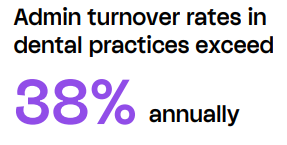
What our research makes clear is that the staffing model many practices still rely on—entirely in-house, entirely local—has stopped being sustainable.
In today’s market, hiring a new in-house treatment coordinator or insurance verifier can take 35+ days and cost thousands. And retention isn’t improving, only 61% local admin hires stay for more than a year, according to our survey findings.
Meanwhile, the admin workload keeps growing. Patients expect faster communication. Carriers demand cleaner submissions. And practices are expected to do more, with fewer people.
“If dentists want to protect production, they have to protect the admin infrastructure that supports it,” said Iffi Wahla, Edge CEO.
What practices are doing differently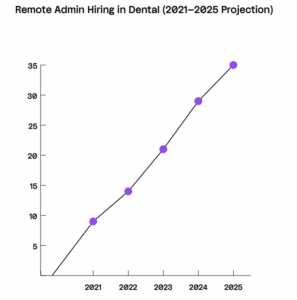
Edge’s report spotlights a new operational model gaining traction: remote-first, compliance-aligned admin teams built from a global talent pool.
The research highlights measurable gains from dental groups that have adopted this model:
- 40% lower staffing costs from offloading admin work to trained remote professionals
- 86% retention rate among global hires, more than 20 points higher than U.S.-based hires
- Faster time-to-fill, with key roles filled in just 12 days on average
Crucially, these professionals aren’t just available, they’re qualified. More than 80% of Edge’s remote talent pool is ready to complete dental-specific compliance certifications, including HIPAA and SOC 2. They’re trained on dental software, workflows, and documentation standards before they ever start.
Raw insight for Dental leaders
If your practice is still relying on front desk teams to carry the entire admin burden in-house, our report offers an urgent look at what that’s costing you.
Download the full report to explore:
- Where admin bottlenecks are impacting production most
- How global teams are helping DSOs and solo practices scale smarter
- The compliance, cost, and retention data behind this shift
Unlock Your FREE Industry Report
More from Dentistry

After Hours Dental Answering Service: Keep Emergency Patients
When a dental patient calls at night with an emergency, an after-hours answering service makes sure someone picks up. That part is easy to solve, and most practices already have. The harder part comes the next morning. An after hours dental answering service usually takes a message, not an appointment. If nobody calls that …

Dental Virtual Receptionist Software Integration Guide
Almost every virtual receptionist provider says it “integrates with Dentrix.” What practices really want to know is simpler: what will this person be able to see and do in their system, and who controls that? Here’s the plain answer. For a real person, dental virtual receptionist software integration just means giving them their own …

Dental Virtual Assistant vs Receptionist: Key Differences
Dental practices hear “virtual receptionist” and “virtual assistant” used almost interchangeably, and it’s hard to tell what you’re actually paying for. The simple difference: a dental virtual receptionist takes care of patients on the phone, like answering calls and booking appointments. A dental virtual assistant takes care of the paperwork behind the scenes, like …

Digital Receptionist for Healthcare: Features That Matter
The demo always shows the same call. A patient phones in, the AI voice agent recognizes her, finds an open follow-up slot and books it in under a minute. It’s impressive, but it’s also the easiest call a practice gets all day. A digital receptionist is software, usually an AI voice agent, chat tool or …